Types of Student Financial Aid: A Complete Guide to Paying for College
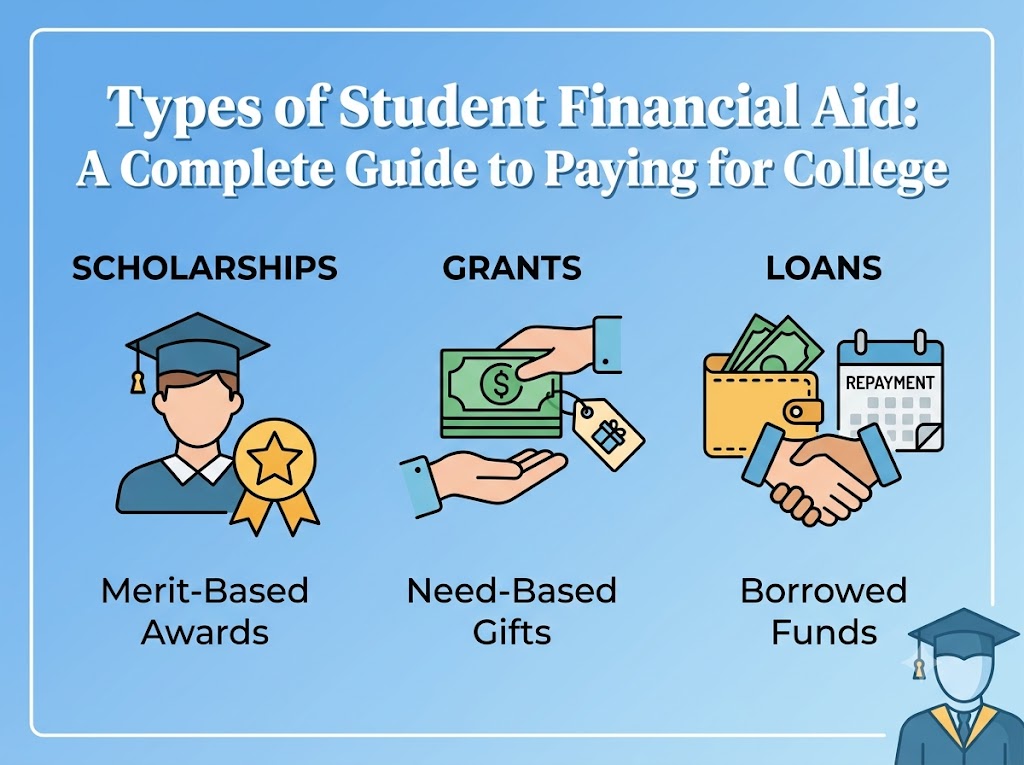
Figuring out how to pay for college can feel overwhelming, especially when tuition prices keep climbing every year. The good news is that most students don't pay the full sticker price out of pocket. Between federal loans, grants, scholarships, and work-study programs, there are multiple paths to funding your education — you just need to know where to look and how each option works.
Below is a breakdown of the four main types of student financial aid, along with practical guidance on how to apply and what to watch out for.
1. Student Loans
Student loans are borrowed money that must be repaid with interest, so they should generally be your last resort after grants and scholarships. That said, federal student loans often come with lower interest rates and more flexible repayment plans than private loans, including income-driven repayment and deferment options if you run into financial hardship.
Before signing anything, compare federal versus private loan terms carefully. Federal loans don't require a credit check for most undergraduates, while private loans usually do and often need a co-signer. Always borrow only what you actually need for tuition, housing, and books — not the maximum amount you're offered.
2. Grants
Grants are essentially free money that, in most cases, doesn't need to be repaid unless your enrollment or financial situation changes significantly during the school year. The most well-known federal grant is the Pell Grant, which is awarded based on financial need as determined by your FAFSA (Free Application for Federal Student Aid).
Beyond Pell Grants, many states and individual colleges offer their own need-based grant programs. Because eligibility is often tied to household income, filling out the FAFSA early — ideally as soon as it opens each year — can make a real difference in how much aid you're offered.
3. Scholarships
Unlike loans, scholarships are a form of gift aid that never has to be paid back. They're typically funded by nonprofit organizations, private companies, community foundations, or the colleges themselves, and awards can be based on:
Academic merit (GPA, test scores)
Special talents (athletics, music, art)
Demonstrated financial need
A specific field of study or career goal
Community involvement or leadership
The key to winning scholarships is applying to as many relevant ones as possible, since even small awards ($500–$1,000) add up over four years. Local scholarships — offered by employers, civic groups, or religious organizations in your area — tend to have far less competition than national ones, so don't overlook them in favor of big-name awards.
4. Work-Study
The Federal Work-Study Program lets eligible students earn money through part-time campus jobs to help cover educational expenses. You'll be paid at least the current federal minimum wage, and many positions are related to your major or community service work, giving you relevant experience alongside your paycheck.
Work-study earnings are paid directly to you, typically on a regular payroll schedule, and the income doesn't count as heavily against your financial aid eligibility the following year compared to a regular job.
Visit the Types of Financial Aid page on StudentAid.govHow to Avoid Financial Aid Scams
One of the most important things to know is that you should never have to pay a company to find scholarships or grants for you. Legitimate financial aid information is free and available through:
The FAFSA and StudentAid.gov
Your school's financial aid office
High school or college guidance counselors
Free scholarship search databases
If a company guarantees you'll win a scholarship, pressures you to pay an upfront fee, or asks for your bank account information to "hold" an award, treat it as a red flag. Ask questions like: Is this service free? Can I verify this organization independently? What happens if I don't win anything? Legitimate aid never requires payment to access.
Final Thoughts
Paying for college doesn't have to mean taking on massive debt. By combining grants and scholarships (free money) with work-study income and only borrowing loans when necessary, you can significantly reduce how much you owe after graduation. Start by completing the FAFSA every year, research scholarships early and often, and always verify that any aid opportunity is legitimate before sharing personal information or paying a fee.
#StudentFinancialAid #CollegeGrants #StudentLoans #Scholarships #WorkStudy #FAFSA #PellGrant #PayingForCollege #CollegeTuition #FinancialAidTips