The Family and Medical Leave Act (FMLA): A Complete Guide to Your Rights
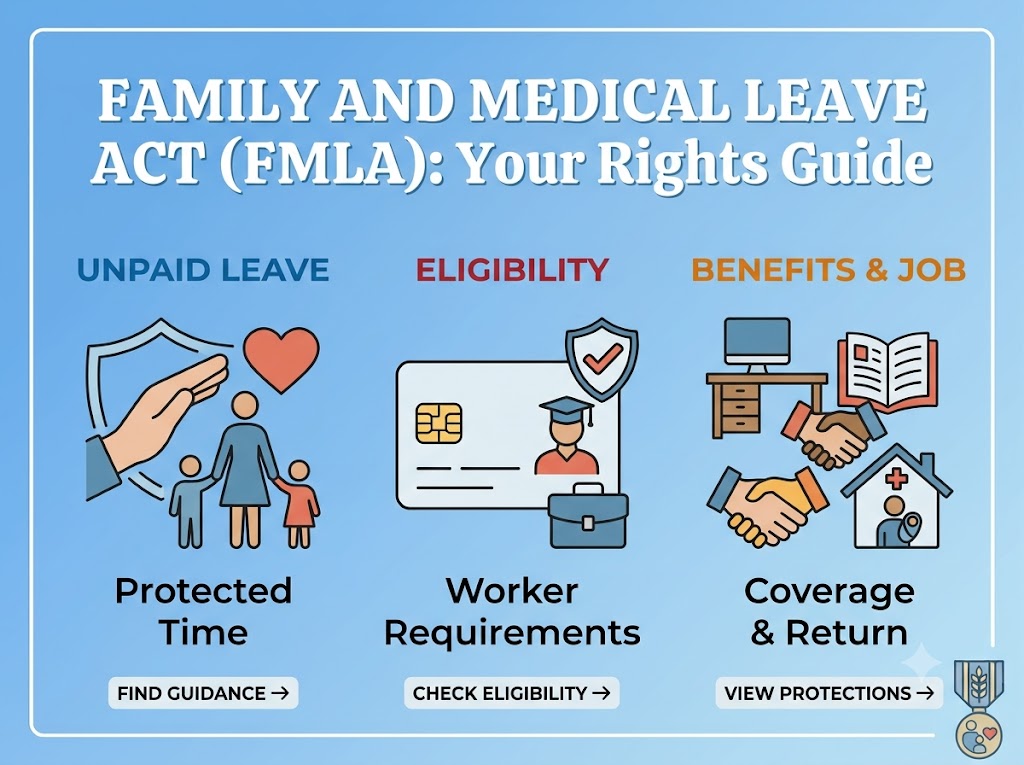
Dealing with a serious illness, welcoming a new child, or caring for a sick family member is stressful enough without also worrying about losing your job. That's exactly what the Family and Medical Leave Act (FMLA) was designed to prevent. This federal law allows eligible employees to take unpaid leave for qualifying medical or family reasons while keeping their job and health benefits protected.
If you're trying to figure out whether you qualify for FMLA, how to apply, or what to do if your employer isn't following the rules, here's everything you need to know.
What FMLA Benefits Actually Cover
FMLA allows eligible employees to take up to 12 weeks of unpaid leave within a 12-month period for a range of qualifying life events. These typically include the birth or adoption of a child, caring for a spouse, child, or parent with a serious health condition, or dealing with your own serious health condition that makes you unable to perform your job.
During that leave, your employer is legally required to protect your position — meaning you're generally entitled to return to the same job or an equivalent one — and must continue your group health insurance coverage under the same terms as if you were still working. You can review the full list of qualifying events and benefit details directly from the U.S. Department of Labor.
Who Is Eligible for FMLA?
This is where a lot of confusion happens, because being employed doesn't automatically mean you're covered. Eligibility depends on both your employer and your individual work history.
Employer Coverage
FMLA only applies to certain types of organizations, including:
Private companies with at least 50 employees
All government agencies (federal, state, and local)
All public and private elementary and secondary schools
If your employer doesn't fall into one of these categories, FMLA protections likely won't apply — though your state may have its own separate leave law that does.
Employee Eligibility
Even if you work for a covered employer, you must meet all three of the following requirements to qualify:
You've worked for your employer for at least 12 months (they don't need to be consecutive).
You've worked at least 1,250 hours for that employer in the past 12 months.
Your employer has 50 or more employees within 75 miles of your worksite.
Because these rules can get complicated depending on part-time schedules, multiple worksites, or recent job changes, it's worth double-checking your specific situation rather than assuming you don't qualify.
State Family Leave Programs
Some states have their own family and medical leave programs with different — sometimes more generous — eligibility rules than federal FMLA, and a few even offer paid leave. It's worth checking whether your state has its own program in addition to federal protections, since you may be entitled to more than FMLA alone provides.
How to Apply for FMLA Leave
The process starts with you: notifying your employer that you need to take leave for a qualifying reason. Once notified, your employer is responsible for determining your eligibility and providing the required paperwork. The FMLA leave process guide from the Department of Labor breaks down exactly which steps fall on you and which are your employer's responsibility, which can help you avoid delays.
In many cases, you'll need to submit a certification form to verify the reason for your leave — for example, a medical certification from a healthcare provider. The Department of Labor maintains a full list of official FMLA forms, and your employer will tell you exactly which one applies to your situation.
What to Do If Your FMLA Rights Are Violated
FMLA is enforced by the Department of Labor's Wage and Hour Division (WHD), and violations are taken seriously. Common violations include:
Denying an employee's legitimate FMLA request or interfering with their right to take leave
Manipulating an employee's hours specifically to avoid FMLA eligibility requirements
Retaliating against an employee for taking FMLA leave or participating in an FMLA-related investigation
If you believe your employer has violated your FMLA rights, you can contact the Wage and Hour Division directly at 1-866-4US-WAGE (1-866-487-9243), available Monday through Friday from 8:00 AM to 4:30 PM local time. You can also find your nearest local WHD office to file a complaint in person or by phone.
For a deeper understanding of what protections the law provides — and what your employer legally cannot do — it's worth reviewing the Department of Labor's fact sheet on FMLA protections.
Final Thoughts
FMLA exists to make sure a medical emergency or family crisis doesn't also cost you your job. If you think you might need leave in the near future, it's a good idea to review your eligibility early, understand your employer's specific process, and keep documentation of your communications along the way. And if something feels off — whether it's a denied request or pressure not to take leave you're entitled to — don't hesitate to reach out to the Wage and Hour Division for guidance.
#FMLA #FamilyMedicalLeaveAct #EmployeeRights #UnpaidLeave #FMLAEligibility #WageAndHourDivision #MedicalLeave #JobProtection #FMLAViolations #DepartmentOfLabor