Apostille vs. Authentication Certificate: How to Legalize U.S. Documents for Use Abroad
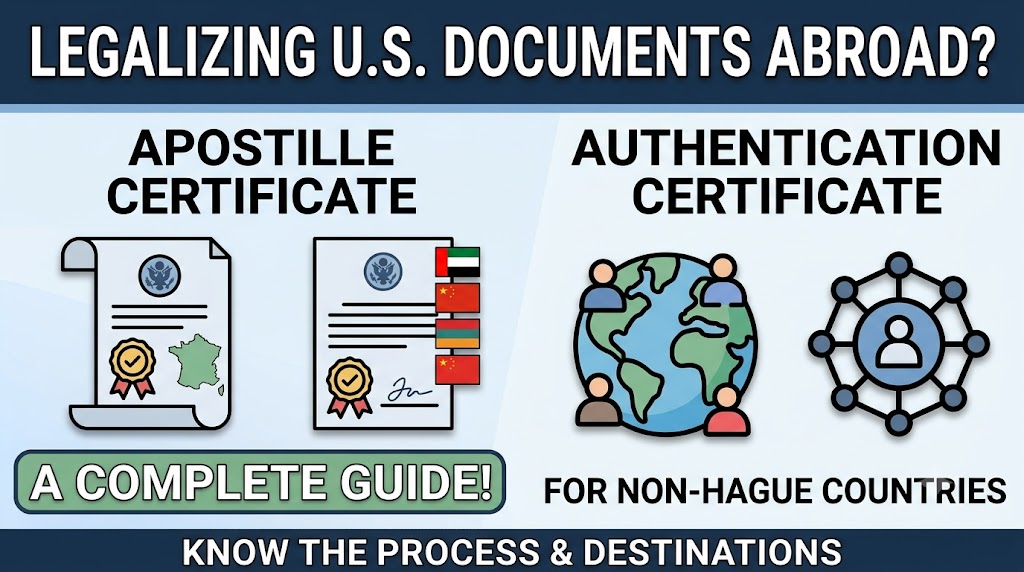
If you've ever tried to use a U.S. document — a diploma, a birth certificate, a court order — in another country, you've probably run into a confusing requirement: the document needs to be "authenticated" or "apostilled" before a foreign government will accept it as legitimate. If those two terms sound interchangeable, you're not alone in being confused. They're actually two different processes, and using the wrong one can mean delays, rejected paperwork, and a lot of wasted time.
Here's a clear breakdown of what apostilles and authentication certificates actually do, and — most importantly — how to figure out which one you need.
What Do Apostilles and Authentication Certificates Actually Certify?
Both apostilles and authentication certificates serve the same basic purpose: they verify the signatures, stamps, or seals on official documents, confirming to a foreign government that the document is genuine and was issued by a legitimate U.S. authority.
This matters for a wide range of document types, including:
Court orders
Contracts
Vital records (like birth or marriage certificates)
Educational diplomas and transcripts
And more
The key question that determines which certification process you need isn't the type of document — it's the country where you plan to use it.
How to Get an Apostille (and When You Need One)
If your destination country is a member of the 1961 Hague Convention, you'll need an apostille. You can check the full list of Hague Convention member countries to confirm whether your destination qualifies.
Where you get your apostille depends on the type of document:
State-issued documents — like vital records — need an apostille from that specific state's secretary of state.
Federal documents need an apostille from the U.S. Department of State.
To make this easier, you can use this directory to find the correct contact information for getting an apostille, whether that's through the U.S. Department of State or your particular state's secretary of state office.
Once you know where to apply, it helps to walk through the process step by step. You can learn the exact steps required to obtain an apostille, and once you've submitted your documents, you can check the status of your apostille request to track its progress.
How to Get an Authentication Certificate (and When You Need One)
If your destination country is not on the 1961 Hague Convention member list, you'll need a different process entirely: an authentication certificate.
This process is a bit more involved than an apostille, typically requiring additional steps such as legalization through the destination country's embassy or consulate after the initial U.S. authentication is complete.
You can learn more about authentication certificates, including:
Which types of state and federal documents require authentication
The specific steps involved in the authentication process
Just like with apostilles, once you've submitted your paperwork, you can check the status of your document to see where it stands in processing.
Fees and Submission Details
Both apostilles and authentication certificates come with associated fees, and the exact cost depends on the type of service and how many documents you're submitting. Before you send anything in, it's worth reviewing the full breakdown so there are no surprises.
You can find current fees for authentication services, along with instructions on where to submit your documents — whether that's by mail or in person.
Quick Summary: Which One Do You Need?
If you're still not sure which process applies to your situation, here's the simplest way to remember it:
Destination country is a Hague Convention member? → You need an apostille.
Destination country is not a Hague Convention member? → You need an authentication certificate.
From there, whether you're dealing with a state-issued vital record or a federal document determines exactly which office — your state's secretary of state or the U.S. Department of State — will handle the certification.
Final Thoughts
Getting a document apostilled or authenticated might seem like a small bureaucratic hurdle, but it's a step that foreign governments, universities, and courts take seriously — and skipping it, or using the wrong process, can set you back weeks. Before you submit any paperwork, confirm whether your destination country is part of the Hague Convention, identify whether you're dealing with a state or federal document, and follow the appropriate process from there.
A little extra care at this stage means your documents will be accepted the first time, without unnecessary delays.
Disclaimer: This article is for general informational purposes only and does not constitute legal advice. Always verify current requirements with the U.S. Department of State or your state's secretary of state office before submitting documents.
#Apostille #AuthenticationCertificate #HagueConvention #USDepartmentOfState #DocumentLegalization #InternationalDocuments #VitalRecords #NotarizedDocuments #TravelTips #LegalDocuments